Furnaces, ovens, boilers, exhaust systems, steam lines, foundries, welding stations, and other processes generate heat because production depends on it. But when ambient temperatures rise too, the total amount of heat that workers and nearby equipment have to deal with changes.
An Occupational Health & Safety article on heat stress and protective apparel describes how employers are reconsidering the heat burden associated with flame-resistant (FR) and flame-resistant/arc-rated (FR/AR) clothing, especially during long shifts in already-hot environments.1
What workers wear is only part of the heat they experience. Equipment, piping, process surfaces, and other hot sources add even more to conditions on the plant floor.
Industrial heat protection helps reduce some of that added exposure. Insulation, barriers, shielding, sleeves, blankets, curtains, and other engineered textile products limit how much process heat reaches workers, nearby components, or occupied areas.
Ambient Heat Changes the Baseline
A furnace might operate at the same process temperature even as the surrounding work area becomes much hotter. Warmer seasonal conditions in the last few years, hotter ventilation intake air, and heat retained inside the building all raise the starting temperature before process heat is piled on. Over time, heat exposure also affects nearby hoses, cables, seals, and other components.
OSHA’s proposed federal Heat Injury and Illness Prevention rule recognizes this combination. The proposal applies to indoor as well as outdoor work and notes that furnaces, ovens, machinery, and other heat-generating processes create hazardous indoor conditions when cooling measures aren’t in place.2
OSHA’s framework also considers workload, clothing or PPE, acclimatization, and other factors alongside environmental conditions. Two employees in the same room could experience different heat loads depending on the task, protective gear, location, and proximity to radiant heat.2
OSHA proposed an initial heat trigger at a heat index of 80°F and a high heat trigger at 90°F, with WBGT-based alternatives tied to NIOSH limits. At the initial trigger, it calls for measures like drinking water, break areas, indoor work-area controls, acclimatization, communication, and rest breaks when needed. At the higher trigger, proposed protections include scheduled rest breaks, closer observation for heat-related symptoms, hazard alerts, and warning signs for excessively hot areas.2
The thresholds don’t tell engineers how to design equipment, but they do show how ambient heat and process heat add up in the same work area.
Some Process Heat Has Somewhere Better to Go
Industrial processes have to stay hot enough to do their jobs. A curing oven, kiln, furnace, exhaust line, or heated pipe still has to operate at the temperature the process requires.
But how much of that heat spreads into nearby work areas? A hot pipe beside a workstation radiates heat into occupied space. An oven exterior adds heat near loading or unloading positions. Exhaust components could sit close to cables, hoses, or maintenance access points. Welding or foundry operations create localized exposure even when the overall room temperature doesn’t seem that extreme.
For indoor work areas with radiant heat sources, OSHA’s proposal lists shielding or barriers, isolation of the source, insulation on hot pipes and surfaces, increasing distance from the heat source, and modifying the hot process or operation as possible approaches. The proposal gives examples involving industrial ovens, kilns, process heat, and welding stations.2
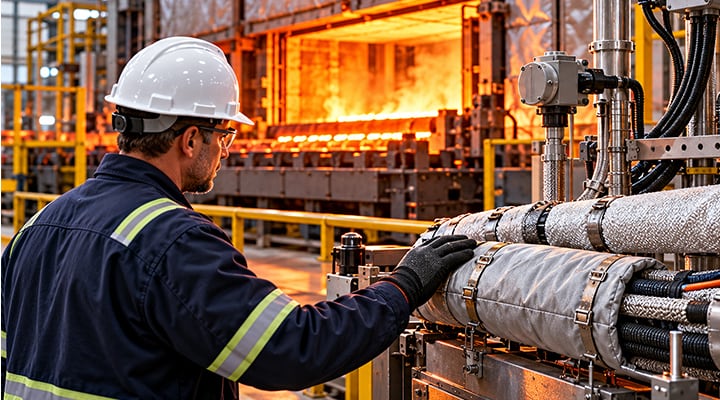
Engineers and plant teams have some options around the equipment itself. Hot piping may be insulated. Removable insulation blankets cover components that still need regular access. Flexible sleeves protect hoses, wires, or cables routed near heated equipment. Curtains, barriers, and reflective constructions reduce radiant exposure in nearby work areas.
Heat protection materials like thermal blankets, sleeves, wraps, curtains, and reflective barriers help reduce unwanted heat transfer without changing the process temperature needed for production.
Thermal protection for industrial equipment works alongside ventilation, cooling, hydration, scheduling, acclimatization, and other worker protections. OSHA’s proposal calls for a mix of engineering controls, work-practice changes, water, rest, cooling areas, communication, training, PPE, and emergency planning.2 Equipment-side thermal protection helps reduce the process heat reaching workers and nearby equipment.
Worker Heat Burden & Equipment Design Are Connected
FR and FR/AR clothing still has to provide the protection required for the job, even in hot conditions. Employees working near furnaces, heated piping, welding stations, or other radiant sources wear that protective clothing on top of the heat already coming from the surrounding environment.
The way hot equipment is insulated, shielded, or positioned affects worker exposure. A barrier around a radiant source may lower heat at a nearby service position. Insulation around piping might reduce surface heat reaching a walkway or work area. A protective sleeve could shield a hose or cable from nearby heat while protecting the component itself. Retrofit projects and planned maintenance give manufacturers a chance to address these hot spots when equipment is already being opened, moved, or modified.
Hotter Conditions Change What Engineers Should Review
For high-temperature equipment protection, hotter ambient conditions are another reason to look beyond maximum process temperature.
Engineers should think about where heat is released during normal production, but also what happens during loading, cleaning, inspection, maintenance, startup, and shutdown. Those tasks normally place people closer to hot equipment than they are during steady-state operation.
OSHA emphasizes identifying heat hazards where work actually takes place. For indoor areas, that might mean monitoring heat index or WBGT and applying controls once trigger levels are reached. Radiant heat sources complicate the picture because heat index alone doesn’t capture every type of exposure.2
When reviewing equipment or a hot-process area, ask these questions, especially when general ventilation or cooling is already in place but certain work areas or pieces of equipment are noticeably hotter than their surroundings:
- Where is heat escaping into occupied areas? Look at exposed piping, exhaust components, equipment surfaces, access points, doors, and other places where process heat reaches the surrounding space.
- Who or what sits in the path of that heat? Operators, maintenance teams, controls, wiring, hoses, sensors, and nearby assemblies may all be affected.
- Is the heat mainly radiant, conducted, or tied to hot air around the process? Different conditions call for different types of insulation, barriers, shielding, or ventilation.
- Does the protection need to come off regularly? Removable blankets or flexible textile constructions may make more sense around components that require inspection or service.
- What else does the material have to tolerate? Abrasion, oils, fuels, moisture, chemicals, vibration, bending, and repeated handling all influence the final construction.
Thermal Protection Has Benefits Beyond Worker Exposure
Process heat also affects the equipment around it. Repeated heat exposure affects hoses, cables, seals, connectors, and other components positioned near hot equipment.
Insulation, shielding, sleeves, and other thermal protection materials serve two related purposes: reducing unwanted heat around work areas and protecting nearby components from thermal exposure.
Davlyn Group develops heat protection materials for demanding industrial applications, including high-temperature fabrics, sleeves, tapes, ropes, blankets, gaskets, and custom fabricated products. Our engineers and material specialists help evaluate temperature, exposure type, equipment geometry, installation needs, and surrounding conditions when selecting a thermal protection approach.
If you’re reviewing thermal protection for industrial equipment or planning around hotter work environments, contact Davlyn Group to discuss your application.
Frequently Asked Questions
What are engineering controls for heat stress?
Engineering controls reduce heat exposure by changing the work environment or reducing heat at its source. Examples include ventilation, air conditioning, insulation on hot surfaces, radiant heat shields, barriers, isolation of heat-generating equipment, and other measures that reduce the heat reaching occupied areas. OSHA’s proposed federal heat rule mentions a few of these approaches for indoor workplaces with heat-generating processes.
How can radiant heat be reduced in the workplace?
Radiant heat may be reduced by insulating hot surfaces, adding reflective shielding or barriers, increasing distance from the source, isolating hot equipment, or modifying the process where feasible. The right approach depends on the temperature, source geometry, worker location, access requirements, and other operating conditions around the equipment.
At what temperature does OSHA consider heat a workplace hazard?
OSHA’s proposed federal heat standard uses a heat index of 80°F as its initial heat trigger and 90°F as its high heat trigger, with WBGT-based alternatives tied to NIOSH limits. Those values are part of a proposed rule rather than a final federal heat standard, and heat risk also depends on factors such as radiant heat, workload, clothing, acclimatization, humidity, and the surrounding environment.
Sources